London, 2019.
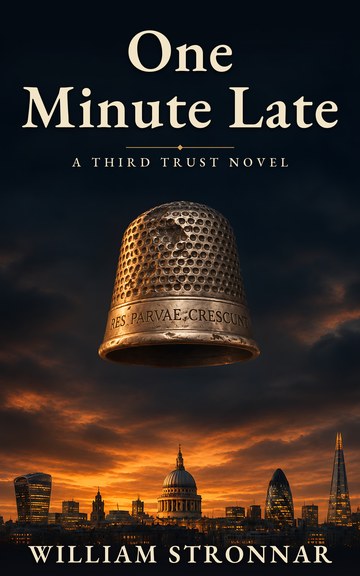
Christopher Mercier is eighty-two, a master clockmaker, and the latest of a family that has lived and worked in Clerkenwell for more than two centuries. He owns a workshop full of clocks, a pub full of friends, and a silver thimble whose purpose his father explained to him when he was twelve.
Then a man he has trusted for twenty years betrays him. His savings disappear, his pub is threatened, and the law offers him no protection. Someone wants his little corner of London, and they have the money and the means to take it.
Christopher has spent his life repairing things other people have broken. He has also spent seventy years keeping a promise.
Now he must decide whether to break it.
A gentle literary thriller about friendship, betrayal, extraordinary power and the courage to use it wisely.
Pre-order: Amazon UK → Amazon US → · out 15 December 2026
Nam concordia parvae res crescunt, discordia maxumae dilabuntur.
In harmony small things grow; in discord the greatest fall apart.
Sallust · The War with Jugurtha
Prologue
Clerkenwell — Tuesday, 24 September 2019
The council had called it Britton Street since 1937. The maps agreed with the council, and so did the postman, but nobody had asked the Red Lion, and on a Tuesday night in September the pub was full of people who still said Red Lion Street as if the name had never been taken away.
There was no music, because there had never been music. There was no television, no fruit machine, and no food beyond crisps and a jar of pickled eggs that Dee kept for reasons of history. There were the walls, and you could hardly see them for pictures: oils, drawings and one small, furious etching, hung edge to edge from the dado rail to the brown ceiling and on up the stairs, the gifts and bar debts and thank-yous of sixty years. Some were by people whose names would fill a saleroom. Some were by people nobody had heard of then or since. The regulars argued about which were which, and the one man who knew had never said.
He was at the long table under the window, because there was room there, wedged between Frank, who had set type in Fleet Street until there was no Fleet Street, and Nadia from the frame-maker’s at No. 31. On her first night in the pub Christopher had told Nadia that she had a surgeon’s hands and should stop wasting them on the cello. She had given up the cello.
He was eighty-two. He had a long face, a nose that came into a room some time before the rest of him, and white hair that stood straight up, as if he had just been told something astonishing, with a beard to match. Tonight he wore the check jacket, the loud one, over a jumper patterned like a Norwegian ski lodge. He was talking. He was nearly always talking, and people were nearly always listening, and Dee, who had run his bar since 1988, had long since given up trying to work out why. It wasn’t the stories, though the stories were good. It was how he looked at you while you told him yours.
She noticed the phone first. It lay face down by his glass, which was the house rule: phones face down, and whoever turned one over bought the round. He had made the rule himself. Tonight she had watched him turn his over twice, look, and turn it back, and nobody at the table had said a word about the round.
Then the door went, and the young woman came in.
Dee had watched a great many people come into the Red Lion for the first time, and most of them did the same thing. They stopped on the mat and looked up at the walls, as people do in a church. This one didn’t. She looked at the people. She took her time over the whole room, as if she were counting, and then she came to the bar, asked for a pint of the bitter, not a half, paid in cash, and carried it to the only free seat in the place, which was opposite Christopher.
“Is this one taken?”
“Not by anyone who matters.” He was already getting up. It took a while. There was a lot of him to unfold, and a bench and a table leg to get round, and Frank’s coat. He got there. He stood until she had sat down, and then he sat, and then he looked at her properly, over the top of his glasses.
She was perhaps twenty-eight, dark, in a leather jacket she showed no sign of taking off, with a face that had been out in the weather. And she had, there was no other word for it and Dee had been looking for one since the door opened, a magnificent bosom.
“Forgive me,” said Christopher. “I’m eighty-two, and I gave up keeping things to myself some time in the nineteen-seventies. You have a truly majestic bosom.”
Frank put his face in his hands. Nadia said, “Chris,” in the voice of a woman watching a dog go for a cake. Further down the table somebody laughed and turned it into a cough, and the man at the end, who had only come in for the cricket score, got up and went to the gents.
The young woman drank some of her bitter and put the glass down.
“Thank you,” she said. “You’ve got a majestic nose. I could hang my jacket on it, if I were taking my jacket off, which I’m not.” She looked at the check. “Is that a jacket, or did you lose a fight with a picnic?”
For a moment it could have gone either way. Then Christopher laughed, the real one, which started somewhere under the table and came up through him like a train out of a tunnel, and he slapped the table so that all the pints jumped.
“Oh, you cunt,” he said, delighted. “Where have you been?”
Nobody who drank at the Red Lion minded the word. From him it was a decoration, handed out as old soldiers hand out a nod, to people who had earned it, and most of them took years. Dee had known a junior minister wait eleven years for his. This one had been in the building four minutes.
“Hackney,” said the young woman. “Mostly.”
“Well, don’t go back.”
“Why did you say it?” She wasn’t cross. She seemed interested. “The bosom. You don’t strike me as a dirty old man.”
“I’m filthy,” said Christopher. “But that’s not why.” He took his glasses off, polished them on the jumper, which made them worse, and put them back on. “I said it because it’s true, and because nobody ever says it nicely. They stare, or they say it nastily, or they say nothing and stare anyway. My mother had one like it. Nobody ever told her nicely either, except my father, and he was a forger, so you couldn’t believe a word.”
“Here we go,” said Frank, into his hands.
“Shut up, Frank, she hasn’t heard it.”
“I’ve heard it.”
“You’ve heard it nine hundred times, and you still laugh in the same place, so shut up.” To the young woman: “Do you want to hear about my mother?”
“Is it long?”
“It’s exactly as long as it needs to be.”
She considered him. “Go on, then.”
He told it the way he always told it, Dee thought. Then she listened for a while, and it wasn’t quite.
“My mother,” said Christopher, “was born over a tripe shop in Exmouth Market in nineteen-twelve, and by the time she was sixteen she had the finest bosom in the borough of Finsbury. That’s not me saying so. It’s documented. There was a man who drove the number 38 who used to stop his bus outside the tripe shop, not at the stop, mind, outside the shop, and everybody on board would just sit there, and nobody complained. Not one of them. She married my father, God help her, and she had me, and she was the most beautiful woman in every room she ever walked into, and she knew it, and she never once used it on anybody who didn’t deserve it. That’s the thing. She could have had anything. She had a kitchen in Clerkenwell and a husband who smelt of glue.”
“Fish glue,” said Frank.
“Fish glue. Thank you, Frank. Anyway. She gets old. Everybody does, I’m told. And at the end she’s in a home in Highgate, a nice one, the third one, because she’d been asked to leave the other two—”
“What for?”
“Fighting.” He waved it away. “And every time I go up, every Sunday, she’s in her chair by the window with her hair done, she always had her hair done, and she looks at me and she says, ‘I’ve had enough, Christopher.’ That’s all. ‘I’ve had enough.’ And I say, Mum, enough of what? And she looks at the garden.”
The table had gone quiet, as it always did for this part, which was why Frank was still there after nine hundred times.
“So the matron takes me aside. And the doctor takes me aside. And a vicar takes me aside, and she wasn’t even C of E, she wasn’t anything, she used to say God knew where she lived. And they all say the same thing with their heads on one side, the way they do. She’s eighty-six, Mr Mercier. She’s tired. Some of them are just ready. And I thought, well. Maybe she is. She’s entitled. So one Sunday I didn’t go home. I sat with her through tea, and through the telly, and through the cocoa, and I said, I’m not leaving, Mum, till you tell me what you’ve had enough of. And about half past nine she gave in.”
He drank, and took his time over it.
“The men,” he said.
The young woman frowned. “What men?”
“In the home. Eighty-six years old, in a cardigan, and every old goat in Highgate was after her. They’d park their wheelchairs next to hers at lunch. One of them used to sit on the arm of her chair and read her the racing results. There was a retired magistrate who dropped his napkin by her feet every day for a year and waited for her to pick it up, and she swore it was always the same napkin. He kept it specially. ‘Christopher,’ she said, ‘I have been looked at since nineteen twenty-eight, and I am tired.’”
The young woman laughed, properly, the way people always laughed at the napkin, and Frank laughed in the same place, as promised, and Christopher laughed with them, and then he stopped.
“Seventy years she was the best thing in every room,” he said, “and nobody ever once let her just sit in one.”
In the quiet Dee could hear the fridge humming under the bar, and somebody’s lighter at the door, where the smokers stood, and the old pipes knocking in the walls.
“What did you do?” said the young woman.
“Took her home. She had my back room for two years, with the clocks. Nobody looked at her there except me, and I’m her son, so I don’t count.” He turned his glass a little on the table. “She was very rude about the clocks.”
He turned his phone over a third time and looked at it for longer, and turned it back. Nobody said anything about the round.
“So have I,” he said. “I’ve had enough.”
Frank laughed, because it sounded like the next line of the story, and then stopped, because it wasn’t. The young woman didn’t laugh. She was watching him the way she had watched the room when she came in.
Christopher got up. It took as long as before: the bench, the table leg, Frank’s coat. Then he came across the room towards the bar, saying sorry to the backs he had to get past, and lifted the flap and came through to Dee’s side.
In thirty-one years he had never once come behind her bar. He owned it, the bar and the building and the ground under the cellar, as his family had for longer than anyone had bothered to write down, and he had never pulled a pint in his life, or poured a measure, or so much as rinsed a glass. He drank on the other side, like everybody else. Dee stepped back from the pumps without thinking, as you’d step back for a hearse.
The box hung on the wall above the till, between the whiskies and a small brown drawing of a horse. It was a plain glass case the size of a hymn book, on a brass hook, and inside it, on a scrap of faded green velvet, sat a silver thimble, dark at the rim, the kind of thing your grandmother kept in a biscuit tin. Dee dusted it on Mondays. When tourists asked about it she told them what she’d been told: it had been in the family since before there was a pub, and it wasn’t for sale.
He reached up and lifted it off its hook.
The Red Lion went quiet. It didn’t happen all at once. It went from the bar outwards, like a stone dropped in a pond, until even the cricket man, coming back from the gents, stopped with his hand on the door. Where the box had hung there was a square of wallpaper the light had never reached, the colour the whole wall must once have been, sharp-edged and much too clean.
Christopher held the box against his chest with both hands. He didn’t open it. He looked at Dee as though she had asked him something, and seemed to decide what the answer was.
“Put their drinks on mine, Dee,” he said. “And hers.”
Then he went round the end of the bar and through the room and out of the door into Red Lion Street. It was a good half-minute before anybody spoke, and it was the young woman. She had turned on the bench to watch him go, and now she turned back to the bar with her pint hardly touched.
“What’s in the box?”
“A thimble,” said Dee. “It’s his family’s.” She didn’t want to look at the clean square on the wall, so she took a glass down and pulled the young woman another pint she hadn’t asked for, and then, because her hands still wanted something to do, she pulled one for Frank.