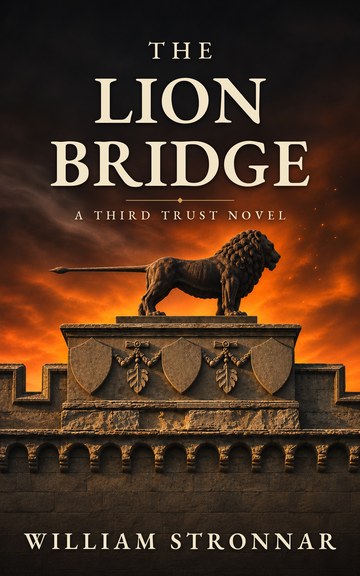
London, 1786. An empire has made a promise it cannot keep. A secret fortune has bought land it cannot own. And the wrong people are prepared to kill for a piece of paper.
Joseph Brant, the Mohawk leader who fought for the British Crown, comes to London demanding justice for his people. His unlikely ally is Hugh Percy, heir to one of England’s greatest fortunes, a soldier who knows the cost of loyalty.
Meanwhile, a clandestine financial trust discovers that its attempt to help impoverished American veterans has inadvertently financed claims to Indigenous land.
When a young Dutch clerk is attacked carrying the evidence, two worlds collide. The struggle that follows will test the Crown, threaten lives and expose the dangerous distance between what is legal and what is right.
A sweeping historical novel of loyalty, betrayal, money and conscience — and the courage to surrender power rather than abuse it.
Pre-order: Amazon UK → Amazon US → · out 1 December 2026
As smoke is driven away… as wax melteth before the fire.
Psalm 68:2
Prologue
Alnwick — Thursday, 20 October 1785
There were thirty people on the bank, and not one of them could swim.
The ford was a hundred yards below the bridge, where the old road went down to the water between two thorn hedges. There was no ford. There was a place where the hedges stopped and the brown water began, and in the middle of the brown water was a cart on its side. The horse was down in the traces with its head going under and coming up, and every time it came up it screamed. An old man was holding on to the high wheel with both arms round the spokes, and the river was pulling at his legs as if it wanted his boots.
It had rained for eight days. On most days a boy could throw a stone across the Aln and a girl could wade it. Today it was the colour of strong tea, and it came under the Lion Bridge in a long smooth hump and went roaring off across the meadow, carrying hay. On the parapet above it the lead lion stood with its tail out straight, as if none of this were its business.
A man came down the Peth from the castle on a grey mare, with a groom running at his stirrup carrying a coil of rope, and the thirty people got out of his way without being asked.
“Who is it?”
“Hindmarsh, my lord. Of Denwick.”
“At the ford? In this?”
“He’s a Denwick man, my lord,” said Coxon, as if that explained everything, which in Northumberland it nearly did.
“Somebody get a boat.”
“There’s no boat this side, my lord,” said a woman, reasonably. “The boat’s down at the mill.”
Nobody moved. They were looking at him and at the rope in Coxon’s hand, and he saw in their faces exactly what they were waiting for.
His right foot was wrapped in flannel inside a boot slit down the side, and it told him in detail what it thought of the idea. He ignored it.
“Give me the rope, Coxon.”
“My lord—”
“I can sit a horse in water. I can’t stand in it. You can stand in it, and you can’t swim. Give me the rope.”
The grey did not want to go in. That was the first sensible opinion anyone had expressed all morning. He put her at it anyway, the rope’s end made fast under his arms, Coxon and three Alnwick men holding the other end on the bank. The cold came over his boots, then his knees, and then the grey was swimming.
You did not fight a river. He had learned that in a creek in Westchester County in seventy-six, with rifles going off in the trees. You let it take you, and you used the horse to steer, and you kept your eye on the place you wanted to be and not on the water.
The river took them down and round in a long curve below the cart, and he got an arm over the high wheel beside the old man and held on.
Hindmarsh looked at him from a foot away. He was sixty and soaked to the scalp, and his face had gone the blue-white of a man who has stopped feeling the cold.
“My lord.”
“Good morning, Hindmarsh.”
“I’d not have tried it if I’d known it was you coming in after me.”
“That’s handsome of you. Can you hold the rope?”
“No, my lord. My hands have gone.”
He got the rope off himself and round the old man with one hand, while the other held the wheel and the river leaned on all three of them like a drunk at a fair. His fingers were not much better than Hindmarsh’s. He got the knot by feel and shouted, and on the bank Coxon and the Alnwick men leaned back like a tug-of-war team at Whitsun.
Hindmarsh went off the wheel and under the water and came up ten yards downstream on the end of the rope, shouting something in the Denwick tongue that needed no translating, and the men on the bank walked him in hand over hand like a salmon.
Which left him, and the grey, and the horse in the traces.
It had stopped screaming. Every few seconds the river put its nose under and it lifted its head out again, and each time the effort was smaller.
He always carried a knife; his wife called it a soldier’s affectation. He got it out of his boot without letting go of the wheel. He cut the near trace, then the off one, then the breeching strap under the water by feel, and the horse was free.
It did not know it. It lay there.
“Get up, you fool. You’re not dead. I’ve seen dead, and you’re not it.”
The horse got its forelegs under it and heaved. It came up out of the river all at once, streaming, and went past him downstream, swimming hard, its harness trailing.
That was when the grey lost her footing.
The river took whatever she had been standing on out from under her, and she went over sideways and he went with her. He had time to think that this was a stupid way to die after Lexington, and that his father would never let him hear the end of it. Then the water closed over his head, brown and loud and cold, and he could not tell which way was up.
He let go of the reins. He kicked off from what might have been the cart and came up with his hat gone, his wig gone and a mouthful of the Aln. The grey came up beside him with her eye on the bank. He got a hand in her mane and let her take him.
She put him ashore on the shingle a quarter of a mile down, among the hay and the broken branches and a drowned sheep, and stood over him with her sides going like bellows, as if she would like an explanation.
He lay on his back on the stones and laughed.
His name was Hugh Percy. He was the Earl Percy, and he was forty-three.
He had been shot at by the farmers of Massachusetts all the way back from Lexington, a dozen miles, from behind every wall in the county; he had commanded a brigade, and sat in three Parliaments, and said things in both that his father had asked him not to say again. He was heir to a dukedom worth, his father’s steward had once told him in a whisper, more than the kingdom of Denmark. He had a wife he loved, a son six months old, and the gout, which had never once been right about anything except the weather. And he had just done, in front of thirty of his father’s tenants, the most foolish thing a man in his position could do, and he would have done it again.
They put Hindmarsh by the kitchen fire at the castle with a blanket round him and a glass of the Duke’s brandy, which was against every rule of the household and which nobody mentioned. Percy changed, and went down to him.
“How’s the horse?”
“Coxon’s got her, my lord. She’s cut her hock, but she’ll mend.” Hindmarsh looked into the brandy. “The cart’s gone. And the load. Eight bolls of oats. The best of what we had.”
Percy knew what they had. Hindmarsh held a hundred and ten acres at Denwick at sixty-two pounds a year, half at Whitsun and half at Martinmas, and the Martinmas half fell due in three weeks. The oats had lain down flat in the August rain all along the coast.
“You were taking them to sell. For the rent.”
“I’d not say so to your lordship’s steward. He’s a good man, Mr Carr. But he has the book. And the book doesn’t care if it rains.”
“No,” said Percy. “It never has.”
He knew the book. It was bound in green calf and lived in a press in the estate office, and he had read it once at nineteen, from end to end, and been sick afterwards. Every name in it was a man who owed his father money, and every one of them paid on the day or was put out. It was the reason the Duke of Northumberland was richer than Denmark.
“I’ll speak to Mr Carr,” he said.
Hindmarsh looked up at him, not quite believing it, and not quite daring not to.
“It’s not charity, Hindmarsh. Don’t look at me like that. A man who’ll ford the Aln in spate to pay my father his rent on the day is a man I’d sooner keep than lose.” He turned to go, and turned back. “And next time, for God’s sake, wait for the water to go down. The rent will wait. The river won’t.”
The letter was on the library table where he had left it at breakfast.
It had come in the Edinburgh bag the night before, by way of Falmouth and London, and it looked it. The cover was stained with salt, there was a Quebec postmark under the London one, and the hand was large and upright and careful, the hand of a man who had learned his letters in a school where they beat you for blots. He had known it in the hall last night and had not opened it, because he wanted to open it in daylight.
Quebec, the 11th September 1785.
My Lord,
I write to tell you that I shall sail for England before the winter, and hope to be in London by Christmas.
You will know what I come for. When I was in London ten years ago, the King’s minister told me that the grievances of my people concerning their lands could not be attended to until his Majesty’s rebellious subjects had been brought to obedience. I took him at his word, and so did my people, and you know what came of it. The peace was made without us. We were not named in it. The land we lived on, and our fathers before us, was given to men who had burned our towns. I come to ask what the King’s word was worth, and what he will give for it now.
I do not ask you to speak for me. I can speak for myself, and I believe I shall be heard better if I do. But I shall be a stranger in London, and the doors there are many and they are heavy. If one of them were yours, I should be glad of it.
I have not forgot the night on Long Island. I do not suppose you have.
I am, my Lord, your friend and humble servant,
Joseph Brant.
August 1776, the night of the twenty-sixth. Ten thousand men moving east along a farm road in the dark, the gun wheels muffled in sacking: no talking, no fires, no pipes. Somewhere ahead was the Jamaica Pass, which the rebels had left with five men in it, because they had not believed anybody would be fool enough to march round that way.
At a halt at two in the morning Percy had looked down from his horse, and there was a man walking at his stirrup as if he had been there all night: a tall young Mohawk in a blanket coat, with a long, grave, rather humorous face, who said in excellent English, “Your column, sir, is making a noise like a herd of cows going to market. There is a tavern at the head of the pass with five officers in it, and they are not asleep. Send me and four of yours, without the cows, and I will bring them back to you.”
He had sent him. God knew why. At three in the morning five American officers were brought down the road with their hands tied, taken at the door of Howard’s tavern without a shot, and by nine the whole American left had been rolled up like a carpet.
Afterwards they had sat on a fence by the Flatbush road, the Earl Percy and Joseph Brant, eating a cold chicken with their fingers, and talked for an hour about horses, Shakespeare and the King, of whom Brant knew more than Percy found comfortable. They had written, on and off, for nine years. Brant had never once asked him for anything.
Until now. And now it was only a door.
Frances was in the nursery with the boy on her knee.
“Coxon says you went into the river.”
“I went into the river.”
“With your foot.”
“The foot came too. It insisted.”
She looked up then, and took in the wet hair and the way he was standing with his weight off the right side, and put it all away to be discussed later.
“There were thirty people on that bank, Hugh. I’ve had it from three of them already.”
“Then you’ll know none of them could swim.” He looked down at the boy, who had been named Hugh after his father and his grandfather; before that the Percys had all been Henrys, and had mostly been beheaded. “Frances. We’re going to London.”
“In November? Your father isn’t expecting us till after Christmas.”
“Joseph Brant is coming. From Quebec. He’ll know nobody, and he’ll go to the ministry on his own because he’s too proud to do anything else, and they’ll make him sit in an outer room for a month and then give him a dinner and a speech and nothing at all.” His voice was getting louder and he let it. “They took his people into the war on a promise, and made the peace in Paris and never wrote his people’s name down, and now they’ll do it to him again, and I will not have it. Not while there’s a Percy in London with a door.”
The boy took his fist out of his mouth and considered whether to cry.
“Hugh. You’re shouting at the baby.”
“I’m shouting at Lord Sydney.”
“Lord Sydney isn’t here. The baby is.”
His son was examining him with an expression of polite disapproval so exactly like his grandmother’s that Percy laughed out loud.
“We’ll go up on the first of November,” said Frances. “That gives me ten days, which is not enough, but I’ve managed with less.” She put the boy on her shoulder. “And Hugh. Your friend asked you for a door. He didn’t ask you for a cannon. He says he means to speak for himself.”
“Coxon hasn’t read my letter.”
“Coxon reads everything. So does everybody in this house.” She went past him to the door. “Open the door. Then stand out of the way. That’s harder than the river, my love. You’ll see.”
He rode out in the late afternoon, down the Peth to the river, because the foot was worse lying down.
The rain had stopped. The sun had come out low and yellow under the clouds, and the valley was steaming. The river had dropped a foot since noon, and down at the ford two Denwick boys were wading out to the wreck of Hindmarsh’s cart with a rope.
He stopped on the crown of the Lion Bridge.
It was his father’s bridge. Most things in Alnwick were his father’s, and the things that were not had generally been asked. After the great flood of seventy-one his father had sent to Mr Adam for a design and got a handsome one: three wide arches of yellow stone and a little one for the meadow, battlemented along the top like a castle that had lain down across the river to rest, and on the parapet above the middle arch, on a plinth carved with three shields, the lion, cast in lead. His father, who had been born Hugh Smithson and had come by the name of Percy through his wife, had never been content to put up one of anything when he might put up four. Percy had once counted thirty-one lions between his bedroom and the stables, and stopped, because it was making him ill.
But he liked the one on the bridge. It faced a little east of north, along the road that came down out of Scotland, and it watched that road as if it knew what had come down it before and expected it again, and was not afraid.
His father had built the bridge to say whose town this was, and every stone of it said Percy. But a bridge was a bridge, whatever it said. It took you over. It did not ask whose you were. Hindmarsh’s cart would go over it next week. So would the Edinburgh mail, the drovers, the Scots coming south to look for work and the soldiers going north to look for Scots, and none of them would need to know the river’s moods to cross it.
He thought about a door in London, and a man who had walked at his stirrup through the dark without being asked, and what it meant to give a door and nothing more. Frances was right. It would be harder than the river.
Below him the Denwick boys got their rope on the cart and hauled. It came up out of the shallows with a great sucking noise; one of them sat down in the river up to his chest, and the other laughed so hard he let go of the rope.
Percy laughed too, alone on the bridge.
Then he turned the grey’s head for home, up the Peth towards the castle and the town beyond it, which was the way to London too, in ten days’ time; and rode off the Lion Bridge with his boots still wet; and behind him the lion went on watching the north, with its tail held out straight after him, pointing the way he had gone.
That is the end of the prologue of The Lion Bridge, a novel that stands on its own. It follows Percy to London for the winter of 1785, where his old friend Joseph Brant has come to ask what the King’s promises were worth.
The Lion Bridge is published as an ebook on 1 December 2026. Pre-order: Amazon UK · Amazon US